Diego AS
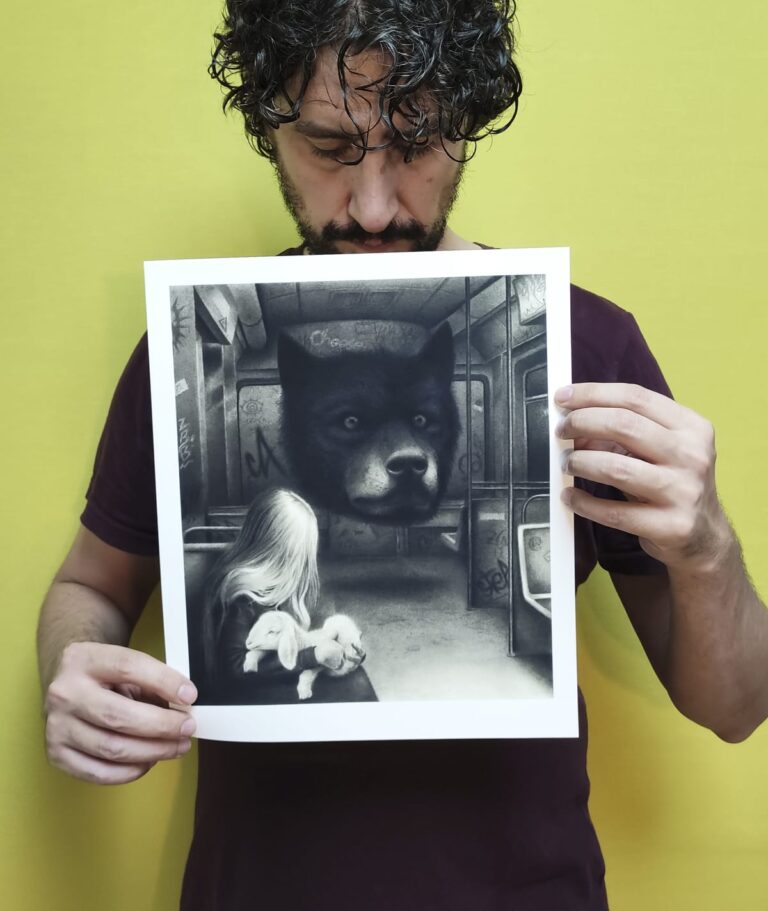
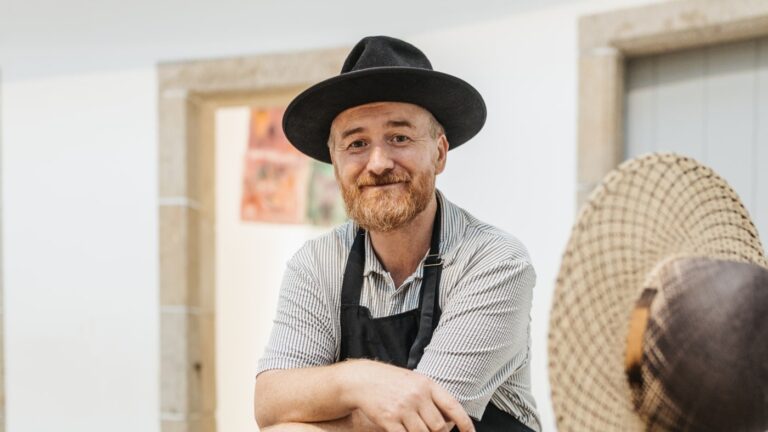
Oh, the nostalgia for the 90s! When urban art was in fashion, irreverence, and street life. It was so alive that some forms of expression, like graffiti, were prohibited, considered vandalism. And so it continued well into the 2000s, when, in the throes of adolescence, Diego Anido Seijas held his first can of spray paint in Lugo. It was the beginning of the renowned Galician artist Diego AS.
Fortunately, graffiti is no longer an illegal activity; it requires training, is commissioned, is entered into competitions, and is admired and applauded in major cities around the world. A logical evolution of this art form that beautifies cities by leaving messages on their walls.
His design, Julio César, on a wall in Lugo, was considered the best graffiti in the world in 2021 by a specialized platform. Diego AS tells us more about his work and life:

Hello Diego. We know you studied graphic arts, but what exactly pushed you to get started in the world of graffiti?
I came from being an average student; I couldn't concentrate in school, and I was always drawing. I discovered graffiti when I was twelve; a few of us formed a group in a more rebellious way while listening to hip-hop. Later, in my twenties, I studied screen printing, engraving, etc., which helped me a lot artistically. I worked for a while in graphic design companies, but the demand for graffiti made me pursue my original dream.
Do you have a favorite piece of your work?
Well, I have fond memories of painting my cousin Ana during a very exciting time when everything was new to me, when there was a lot of technical advancement, I hung out with many graffiti artists, and there was a lot of color.
Also, an emblematic piece, without a doubt, is Julio César, because it marked a turning point in my career.
Can we apply the concepts of “sustainable” or “artisanal” to any part of your work?
The entire process is artisanal, from the initial idea to the final execution. As for sustainability, well, it's a world of harsh materials, sprays, diluents… but I try to use water-based or acrylic paints whenever possible, for the sake of the planet and myself, since I've been exposed to these materials for many years.
The most sustainable aspect is the message I convey through my work: calm, nature, which is the direction I'm heading in now. Realizing that simplicity is the most coherent approach.

What's your favorite place in the province of Lugo?
The mountains. I enjoy walking in the mountains, among groves, for example, in the areas of Penarrubia, Segade, the Mera River… In the summer, I go to Foz with my wife. I find the Lugo coast spectacular.
Awards and mentions recognize your work, but to what extent do they motivate you to keep working and improving?
It's recognition of your work, and that's good, but you can't rest on your laurels. There was a time when I got complacent, a false sense of security after the Julio César award, when everyone wanted a DiegoAS, and I thought I had it all, and that wasn't the case. You always have to keep your feet on the ground, motivate yourself to improve, discover new artists and techniques, learn from art history, and ultimately, enrich yourself.
In my day-to-day work, I look for my own style, where I feel comfortable working for a while.
Besides creating top-level urban art, what other projects are you working on?
Yes, now, in addition to my main project, which is spending time with my children, I'm immersed in my studio and working on small canvases. I play with volumes, like 3D, and I do crafts on furniture, decorations…


Do you use Artificial Intelligence?
Since it first appeared, I was reluctant. I always preferred to create designs manually or with design software, but several friends encouraged me to use Artificial Intelligence, and now I like it. I give the AI the code, and then I develop and finish the ideas it gives me. Knowing how to use it is a tool that saves us work and time, but it shouldn't dictate the work.
Where do you feel most comfortable in your day-to-day work?
I feel good with medium-format murals because I can handle the space and the design well, either physically or visually. On the contrary, if they're very large, I have to approach them like a marathon, very slowly, because they take up a lot of energy. I went through a period of very physical and mental exhaustion.
Do you have any hobbies outside of work?
Yes, I've always been very athletic. Now I'm going swimming again, cycling, I'm starting boxing, and fishing, which I've neglected... I spend most of my time on crafts with my children as a hobby.


Where is your most distant work located?
I think it's in the town of Yauco, in Puerto Rico. They had a very beautiful project there called Miradas de Barrio (Neighborhood Glimpses), and what I did was paint a large gaze on a big wall on a hillside, visible from afar.
What is your vision of Diego AS in twenty years?
The truth is, I have no idea. I'll continue painting in one way or another, because I'm passionate about it, but I think it will be something very different, in a village, with a garden, with animals, with good health, without depending on many things, and with sustainability as a way of life.

Our previous protagonist, Rodrigo Gálvez Tattoo, left this question for the next one: When you lack inspiration, what do you turn to for it?
Very simple. When I'm not focused, I play sports, I move around, I leave the studio, I walk in the mountains, I read, and above all, I don't obsess; I wait for the ideas to come to me.
Yes. Do you have a favorite singer or musical style to listen to while working or relaxing?
Yes. Do you have a favorite singer or musical style to listen to while working or relaxing?